What Are Nano Brows vs Microblading?
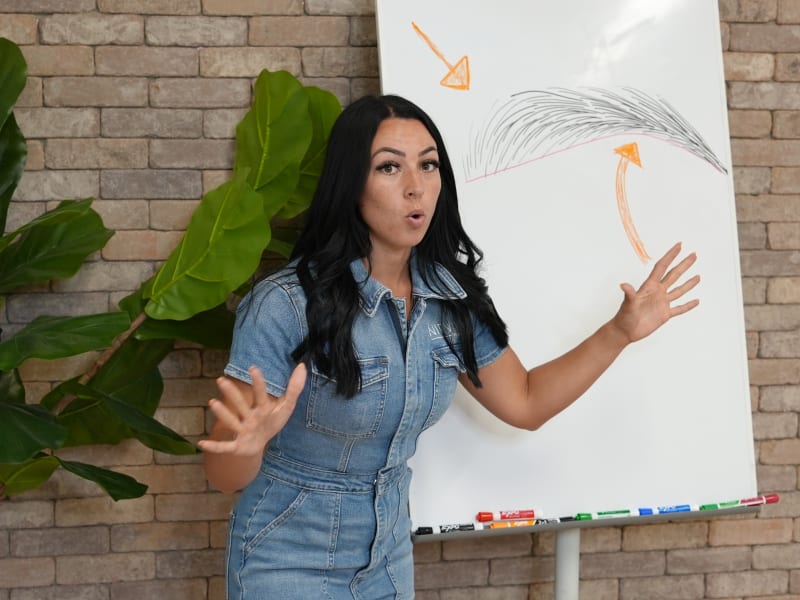
Nano brows use a digital machine to tap pigment in point by point; microblading uses a manual tool drawn through the skin by hand. Machine versus hand is the entire technical difference, and it drives everything else — how much pigment ends up in your skin, how long it lasts, and how natural it looks as it ages.
I get asked this constantly, and there’s a version of the answer floating around the internet that I want to deal with up front. That version says the choice comes down to your skin type: dry skin gets microblading, oily skin gets the machine. I don’t run it that way, and the reason isn’t stubbornness — it’s what I’ve watched happen to brows over ten years and 3,500+ treatments.
Here’s the version I give in the chair.
How Each Technique Works
Microblading
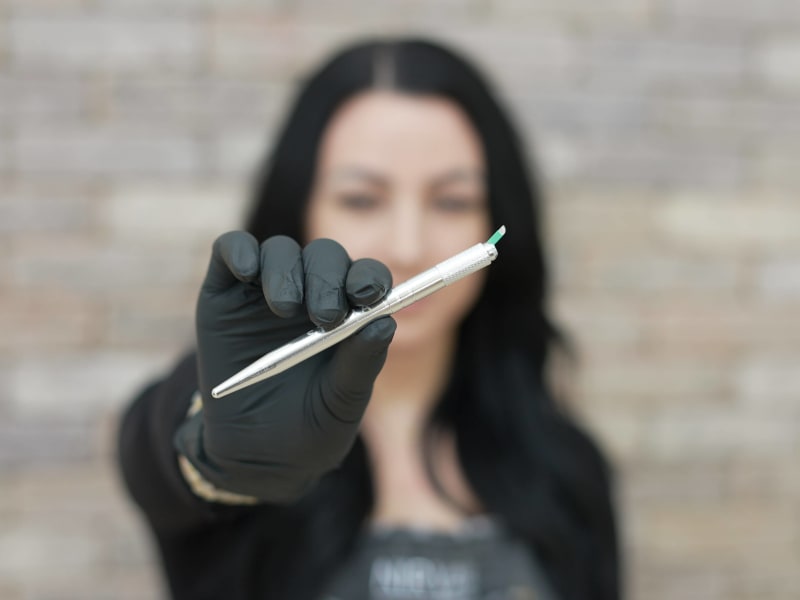
Microblading uses a manual tool — a small row of ultra-fine needles on a handle. I draw each stroke by hand, one at a time. No machine touches your face at any point in the appointment.
Depth is controlled entirely by my hand pressure, which is the part that takes years to get right. Too shallow and the pigment won’t hold. Too deep and the stroke blurs and spreads. There’s a sound that tells me I’ve hit it correctly — a faint velcro noise as the needles move through the skin. No sound means I’m riding too shallow, and too much blood means I’ve gone too deep. That’s the feedback loop, and there’s no machine mediating it.
Nano Brows
Nano brows (also called nano needling or digital microblading) use a PMU machine — a device that drives a single, extremely fine needle up and down at a set speed and depth. Instead of drawing a stroke in one pass, the artist taps it in point by point, building each stroke out of tiny dots.
The machine holds depth consistently, which is genuinely useful. It also implants more pigment than a manual tool does, because of that rate of implantation. Hold onto that second part — it’s the whole story of this comparison.
I should say plainly that I don’t perform nano brows. I do microblading and combination brows, brows only. So what follows is how I compare the two after a decade of watching healed work, not a pitch for something on my own menu.

Saturation Is the Real Trade-Off
A machine puts more pigment into your skin than my hand does. That isn’t a knock on machines — it’s the mechanical fact underneath every claim you’ll read about nano lasting longer. It does last longer. It also reads less like hair as it ages. Those are not two findings. They’re one fact, seen from two sides.
The word for it is saturation: how much pigment is sitting in a given patch of skin. Sparse pigment reads as separate hairs, because that’s what separate hairs look like. Dense pigment reads as a filled shape, because that’s what a filled shape looks like. Time pushes everything toward the shape.
So if you rank the three techniques by how natural they stay as they age, the order is consistent and it isn’t close:
- Microblading only — least saturated, ages most like real hair
- Combination brows — manual strokes plus a light, placed amount of machine shading
- Machine-only work, including nano — most saturated, most durable, least hair-like over time
Read that ranking carefully, because there’s a wrong conclusion sitting right next to the right one. The wrong one is “microblading is always best.” It isn’t — combination brows have real indications and I recommend them when they fit, which I’ll get to. The right conclusion is narrower: the trade runs one direction, so I start you at the end of the line that still has choices in it.
What Skin Type Actually Changes
Your skin type changes your aftercare and it changes how fast your pigment fades. It does not choose which tool goes on your face. This is the single most common thing I end up correcting at consultations, and I understand why it’s out there — the myth has a real mechanism behind it, which is exactly what makes it convincing.
Oily skin does push pigment out faster. That’s true, and I plan around it. It’s why your fade timeline sits at the shorter end of the range, why I’ll talk to you about how you cleanse in the brow area, and why I’ll be honest about how often you’ll want a refresher. What it does not do is decide the technique.
Because notice what the shortcut actually recommends: it says the answer to faster fade is more pigment. That’s not wrong mechanically — more pigment does buy you months. It’s just paying for those months with the thing you came to me for. If you wanted brows that look like they were drawn on, the shortcut is a good deal. Nobody who sits in my chair wants that.
And dry skin doesn’t buy you the two or three years the charts promise — it lands in the same 12-18 month window normal skin does. Same technique, same calendar, a different aftercare conversation. That’s the whole of what your skin type buys you in this decision.
Where Combination Brows Actually Come In
Combination brows are microblading plus a light, strategically placed amount of machine shading. They have two real indications, and neither one is a skin type:
- Brow hair that’s thick and coarse but genuinely patchy — strokes alone can’t bridge a bare gap that sits next to dense existing hair without looking like a bare gap with strokes in it
- You want more definition than hair strokes alone give you — some people fill their brows in every morning and feel wrong without that density, and that’s a legitimate thing to want
Worth clearing up: “dramatic” is a dial, not a category. How bold combination brows look is set entirely by how much shading gets added, and a light hand reads soft. Combination brows are not automatically a bold brow.
Here’s how that decision actually gets made in my studio, which surprises people. I complete all the microblading first — every stroke, both brows, finished. Then I hand you the mirror. You’re looking at your own face with real hair strokes on it, not a drawing and not somebody else’s healed photo. Only then do you tell me whether you want shading added. Same appointment, same chair, after you’ve seen it.
I don’t want you deciding this from a menu three weeks before I’ve touched your face. For more on how the two compare day to day, I wrote a full breakdown of combination brows versus microblading.
The One-Way Door
This is the part I most want you to leave with, because almost nobody gets told it before they book.
Adding shading to existing microblading later: entirely possible. I do it regularly at touch-ups for clients whose healed strokes read lighter than they hoped.
Going the other direction: not possible. Manual hair strokes cannot be laid into a brow that’s already saturated with machine shading — there’s nowhere for a stroke to read against. So once shading exists on your brow, whether it’s mine or machine work you had done somewhere else, every touch-up and every annual refresher from that point forward has to be machine work too.
I want to be precise about how final that is, because the softer version of this warning is misleading. The shading does fade, like any pigment does. But to get back to hair strokes you’d have to stop maintaining your brows entirely and let the shading go all the way out — years of deliberately living with brows you’re not refreshing. In practice nobody does that. The realistic reading is: this decision doesn’t reverse.
That’s the whole reason I lean conservative. I can always add. I just can’t take away.
None of which means don’t do it. If you want the shading, that’s a good decision and I’ll give you a beautiful result. What I won’t do is let you make it without knowing it only opens one way.
Healing: What to Expect From Each
The healing arc is the same shape for both, and it’s worth knowing before you book so week two doesn’t send you into a panic.
Days 1-3: Bold and dark — expect roughly 40-50% darker than where you’ll land. Days 4-7: Flaking and itching. Do not pick. Days 7-14: The ghost phase. The strokes look faint or nearly gone as new skin covers the pigment. This is the stage that sends me the most panicked texts, and it resolves on its own. Days 14-28: True color surfaces, settling around 30-40% lighter than what you saw on day one.
Machine work generally peels a little lighter, because a machine needle disturbs less surface than a manual pass does. It’s a real difference and a small one — not a reason to pick a technique.
One thing is identical either way: you need a touch-up at 6-8 weeks. That’s not a repair and it’s not a sign anything went wrong — it’s the second half of a two-part process. Here, that touch-up is a separate $150, not folded into the first session, and I say both numbers out loud before you book anything. I walk through what happens at that appointment in my microblading touch-up guide.
Pricing: What This Costs Here
My pricing is the same whether you finish as microblading or add shading and finish as combination brows:
| What it costs | |
|---|---|
| First session (microblading or combination brows) | $650 |
| Required touch-up at 6-8 weeks | $150 — separate, not included |
| Complete first-year process | $800 |
| Annual refresher, when you want one | $300 |
I don’t charge extra for the added complexity of shading. The goal is the right result for your face, and pricing the techniques differently would put a thumb on that scale.
For nano brows I’m not going to quote you someone else’s price list — it varies by artist and I’d be guessing. If that’s the route you want, I wrote a guide on evaluating a nano artist in the Chicago suburbs so you at least know what to ask.
Longevity: The Machine Lasts Longer. Here’s What It Costs.
Microblading typically wants a refresher somewhere around 12-18 months, and drier skin doesn’t stretch that the way you’ve been told — it sits in the same window. Only excessively oily skin runs shorter, closer to 10-12 months. Sun exposure moves that number more than your technique choice ever will — daily SPF on your brows does more for longevity than anything else you can control, and it costs you nothing.
Machine work outlasts it. I’m not going to attach a number to a service I don’t perform, and you should be a little skeptical of anyone who quotes you a confident range for work they’ve never healed themselves. The direction is certain, though: more pigment in, more months before it’s gone.
Here’s the reframe I’d offer, and it’s the part the longevity comparisons skip. Every extra month of retention is more pigment sitting in your skin — the same pigment that makes the brow read as a shape instead of hairs. You are not choosing between “lasts long” and “lasts less long.” You are choosing what’s on your face during all of those months.
And fading isn’t the flaw in this. Your face at 55 does not want the brows you picked at 40 — the bone structure shifts, the hair thins, the coloring changes. Semi-permanent means I get to keep matching your brows to your actual face as it changes. I go deeper on that in why microblading fades.
What I Actually Recommend
Most people, most faces: microblading only. It ages the most like real hair, and it leaves every door open. That’s where I start unless something specific points elsewhere.
Thick, coarse, but patchy brow hair — or you genuinely want more definition than strokes give: combination brows. Decided in the chair, after the microblading is finished and you’ve seen it on your own face.
You specifically want machine-only hair strokes with no shading underneath: that’s nano brows, and I don’t do it. I’ll point you toward an artist who specializes in it. That costs me a booking. It’s still the right answer when it’s what you actually want.
Whichever way it goes, I’ve turned down work that wouldn’t have looked like it belonged on someone’s face. Brows are the only thing I do, which means I don’t have a second service to fall back on if I get yours wrong.
Making Your Decision
Come in before you commit to a technique. I’ve moved plenty of people between microblading and combination brows based on what their brow hair actually showed me once I could see it up close, and I’ve sent people to nano specialists when that’s what they were really after.
A few things worth thinking about before you come in:
- How much definition do you actually want? Not “which technique” — how you want to look. I’ll translate that into a technique; that part’s my job.
- Is your brow hair patchy in a way strokes can’t bridge? Dense in places and bare in others is the honest case for shading. I’ll tell you what I see.
- Have you had any machine work done before? If there’s existing shading on your brow, that changes what’s possible, and I’d start you from custom treatment instead.
- What’s your skincare routine? Retinols, glycolic acids, and other actives all affect how your pigment holds. This is where your skin genuinely matters — in your aftercare plan, not in your technique.
Clients drive in from across the southwest suburbs for this conversation — from Naperville, Aurora, and Joliet among others. The recommendation doesn’t change by city.
Browse real client results to see the work on actual faces. Then, if you already know you want to get your eyebrows microbladed, book your session — or if you’re still weighing the techniques, book a free consultation and I’ll tell you exactly what I’d do on your face, and why.
The right shape changes everything. Choosing the technique that keeps your options open is how it stays right.
Questions about which technique fits your brows? I answer every message personally — contact me and tell me about your brow hair and what you’re going for. I’m based in Shorewood, IL, and work with clients from Naperville, Aurora, Joliet, Plainfield, and across the southwest suburbs.