Why Doesn’t Microblading Last Forever?
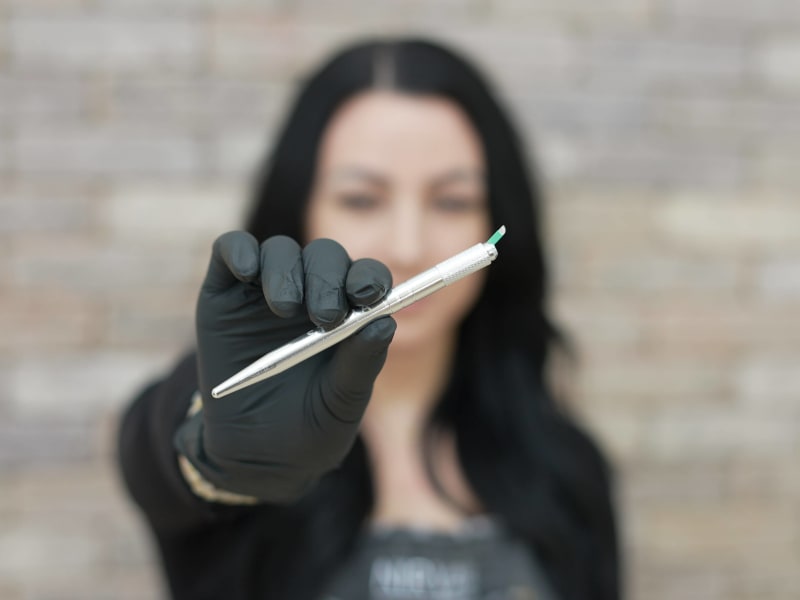
Microblading fades because of where the pigment sits. I place it 0.08 to 0.15mm deep — in the basal layer of the epidermis, the outermost living layer of skin, which your body replaces continuously. That turnover carries pigment out over roughly 12 to 18 months. Fading is the design, not a defect in it.
That depth is the whole difference. Traditional tattooing drives pigment down into the dermis, where the body has a much harder time reaching it — which is why a tattoo on your arm is still there in thirty years, blurred and blue-grey. I stay above that layer on purpose. When I’m working, the depth I’m listening for has a sound to it, a faint velcro drag as the tool crosses the skin. No sound means I’m too shallow and the strokes won’t hold. Excessive blood means I’ve gone too deep, into territory I don’t want to be in on someone’s face. That narrow band between the two is where semi-permanent lives.
So the pigment is sitting in a layer of skin that is never still. Your epidermis is rebuilding itself constantly, and everything that speeds that process up — sun, sweat, heat, active skincare, your own biology — speeds the fading up with it.
Here’s what actually drives it, in the order it matters.
What Happens to Microblading Pigment Inside Your Skin?
Two things happen at once. Your epidermis renews itself and carries pigment outward with the cells it sheds — that’s the main event. Underneath it, immune cells called macrophages break down the particles that settled deepest. Particle size, exactly how deep each stroke landed, and your own immune activity set the pace, which is why two clients with the same brows fade on different schedules.
Pigment implanted in the basal layer isn’t locked in place. It’s sitting in tissue that is actively rebuilding, and your body treats those particles as debris to be dealt with. Between ordinary cell turnover pushing pigment outward and immune cells breaking down what sits deepest, the color thins from both directions.
Three things move the pace:
- Particle size. Larger pigment particles are harder to break down and clear more slowly. Pigment formulation and how the strokes are worked into the skin both affect how those particles distribute.
- Where each stroke actually landed. Depth isn’t uniform across a full brow — it varies stroke to stroke, and strokes that landed a hair too shallow start clearing first. This is exactly what I’m assessing at the 6-8 week touch-up.
- Your own biology. Some people clear foreign material faster than others. That’s partly genetic, partly a function of general health and inflammation, and it’s the variable nobody can predict from the chair on day one.
The touch-up is where this stops being theory. When you come back at 6-8 weeks, I’m reading which strokes held and which ones thinned, and that pattern tells me more about your personal fading timeline than any chart could. A brow that healed evenly is going to age slowly and predictably. A brow where the upper edge dropped out while the body held is telling me your skin is more active than I assumed, and I adjust the refresher interval I quote you accordingly.
How Does Skin Cell Turnover Affect Microblading?
Your epidermis replaces itself roughly every 4-6 weeks at the surface, and the basal layer where I place pigment is the factory floor for that process. As cells move up and out, they carry pigment with them. Active skincare, certain medications, and UV exposure all accelerate the cycle — which is why two clients can leave my chair with identical work and be in completely different places eighteen months later.
You cannot stop this, and you shouldn’t want to. The same turnover that fades your brows is what heals them in the first place. What you can influence is the speed: exfoliants and retinoids push it hard, sun pushes it hard, and heat pushes it hard. Everything else is comparatively noise.
Skin Type and Sebum Production
Excessively oily skin comes back for a refresher around 10-12 months instead of 12-18. That is the entire difference skin type makes, and I want it in front of you plainly, because the skin-type charts floating around promise a spread of years that does not exist.
Sebaceous glands produce sebum, your skin’s natural oil. In excessively oily skin those glands run harder, and the constant oil flow does two things to implanted pigment: it creates a more acidic environment that breaks certain pigment particles down faster, and it physically works pigment out of the channels the strokes created. Crisp hair strokes are the first casualty. Oil doesn’t just lighten the color, it softens the edges of each stroke until the brow reads as a soft powder rather than individual hairs.
This is the point where most artists reach for a different technique, and it’s the point where I don’t. Oil changes how fast you fade and what your aftercare has to work against. It doesn’t change what I pick up at the appointment. Machine shading would hold longer — that part is true, and I won’t pretend otherwise — but it does that by putting more pigment into the skin, and a more saturated brow stops reading as individual hairs sooner. What I do instead is tell you honestly where you’ll sit at twelve months and build your refresher rhythm around that number. If you have oily skin and want the full read, see microblading on oily skin.
What Environmental Factors Make Microblading Fade Faster?
Sun exposure, chlorinated pools, and heat are the three biggest environmental accelerators I see in my Shorewood studio. UV radiation breaks down iron-oxide pigment through photo-oxidation, chlorine gradually degrades pigment particles, and saunas increase macrophage activity. The good news: all three are controllable with simple habits like daily SPF and rinsing after swimming.
Beyond skin biology, external environmental factors significantly affect how long microblading lasts. The ones I see making the biggest real-world difference:
UV Exposure
Sun exposure is the most controllable factor in microblading longevity — and one of the most consistently underestimated.
UV radiation breaks down pigment molecules the same way it breaks down dye in fabric: through photo-oxidation. Iron-oxide based pigments (the most common base in microblading) are particularly susceptible to UV degradation over time.
Clients who spend frequent time in direct sun without protecting the brow area see noticeably faster fading. This doesn’t mean you can’t go outside — it means SPF on the brows after the healing phase (typically after week 4) makes a meaningful difference in how long the pigment holds.
Tanning beds accelerate this significantly. I tell clients who use tanning beds regularly that their results will be on the shorter end of the longevity range.
Chlorine and Pool Exposure
Regular swimming in chlorinated pools has a cumulative effect on microblading longevity. Chlorine is a mild oxidizing agent — the same property that keeps pool water sanitized also gradually degrades the pigment particles in healed brows. The effect is slow and incremental, not catastrophic. But daily swimmers or clients in chlorinated water several times a week should plan for more frequent touch-ups (closer to the 12-month mark) than non-swimmers.
Rinsing brows with fresh water immediately after pool sessions reduces cumulative chlorine contact.
Heat and Sweat
Frequent sauna use, steam rooms, and extended high-heat environments raise skin temperature and circulation, and more circulation means faster clearance. Regular sauna users do land on the shorter end of their range.
Sweat is the version of this question I actually get asked, though, and it deserves a straight answer: sweating does not wash your brows off. Healed pigment is in the skin, not on it. If you log your miles along the Fox River in Yorkville, pencil is what smears on a hard run; healed hair strokes are still there after the run and the shower. What heat and sweat do is nudge the fading timeline, not the brows themselves. If you train hard most days, budget for a refresher a couple of months earlier than someone who doesn’t. That’s the whole adjustment.
Which Skincare Ingredients Make Microblading Fade Faster?
Retinoids are the biggest culprit — prescription tretinoin used anywhere on the face can noticeably shorten microblading longevity by accelerating cell turnover. Chemical exfoliants like glycolic and salicylic acid have a similar effect, especially when applied near the brow area. I ask about your skincare routine at every consultation because it directly affects pigment depth and refresher timing.
Certain skincare actives directly accelerate skin cell turnover and reduce how long microblading lasts:
Retinoids (retinol, tretinoin, retinaldehyde): These are the most impactful. Prescription tretinoin used anywhere on the face — not just near the brows — can noticeably shorten microblading longevity. Retinoids work by accelerating skin cell renewal, which is exactly the mechanism that clears pigment faster.
Chemical exfoliants (AHAs and BHAs): Glycolic acid, lactic acid, salicylic acid. Applied directly to the brow area, these accelerate surface cell turnover and can soften strokes faster than average. Regular use of exfoliating toners or serums on the face affects brow pigment more gradually.
Vitamin C (L-ascorbic acid): Less impactful than retinoids, but high-concentration ascorbic acid serums over time can contribute to faster fading.
If you use any of these products, I’ll ask about your routine at consultation. It informs how I approach pigment depth and which refresher interval to recommend.
How Can You Make Microblading Last Longer?
Two habits make the biggest difference: daily SPF 30+ on the brows after healing, and avoiding retinoids or chemical exfoliants directly on the brow area. Together they decide whether you land at the top or the bottom of your window. I also recommend rinsing after pool sessions, limiting tanning beds, and scheduling annual refreshers at $300 before pigment fades too far.
Knowing what causes fading tells you exactly how to slow it:
- SPF on the brows daily after full healing (week 6 onward) — SPF 30+ is sufficient
- Avoid applying retinoids or chemical exfoliants directly on the brow area — use a thin layer of petroleum jelly or balm to protect the area if your skincare routine requires actives on that part of the face
- Don’t pick or aggressively rub the brow area during healing (week 1-2 specifically)
- Rinse brows after pool sessions to reduce chlorine contact time
- Limit tanning bed use — or apply SPF to brows before sessions
- Annual color refreshers at $300 maintain density without needing a full redo — timing depends on your fading rate
The most impactful combination: daily SPF + avoiding active skincare ingredients on the brow area. Those two habits are worth more months to you than your skin type is — which is the opposite of what most people walk in believing.
How Do You Know When Microblading Needs a Touch-Up?
The right time for a refresher is when brows have faded to about 40-50% of their original saturation — strokes are still visible but lighter than you want. For most clients, that’s 12-18 months, or 10-12 if your skin runs excessively oily. If you notice color shifting to an unusual undertone or significant gaps appearing in the shape, that’s your signal to book before the pigment fades too far for a simple refresher.
Not all fading is created equal. Understanding what you’re looking at helps you decide when to come in.
Normal, healthy fading looks like a gradual softening of the brows over time — the strokes are still visible but lighter than they were at the 6-week healed result. The shape remains intact, the color is still natural-looking, just less saturated. This is exactly how microblading is designed to age.
Fading that signals a refresh is needed looks like: strokes that are no longer visible in certain lighting, color that has shifted toward an unusual undertone (sometimes a cooler or more ashy cast becomes more noticeable as pigment thins), or significant gaps in density that change the overall brow shape.
Fading that shouldn’t happen at this rate: If brows fade significantly within 3-4 months of a fresh session, that points to a potential issue with technique (too-shallow placement), skin type incompatibility, or aftercare failure (particularly exposure to moisture or products during healing). At the 6-8 week touch-up, I can assess whether retention looks appropriate or whether something affected the healing.

When to Book a Refresher
The right time to come in for a refresher is when the brows look noticeably lighter than you want — typically when they’ve faded to 40-50% of the original saturation. Waiting until they’ve mostly faded means more work and potentially a new full session cost.
For most clients, that point comes between 12 and 18 months, and closer to 10-12 if your skin runs excessively oily. I’ll give you a specific estimate at your initial appointment.
The annual refresher at $300 is calibrated for clients hitting that 12-18 month mark. It’s a maintenance session, not a full redo — filling in what’s faded and refreshing the color depth without rebuilding from scratch. If you let it go well past the window, the assessment at that appointment determines whether a refresher or a new full session makes more sense.
How Fading Interacts With Technique
Not all microblading fades at the same rate even on the same skin — because technique affects longevity as much as individual biology does.
Stroke depth and pigment load: Strokes placed at the correct depth — down at the basal layer, not up in the shedding layers above it — retain pigment longer. Strokes placed too shallow start fading almost immediately, because that pigment is sitting in skin that’s already on its way off your face. Go the other direction and you’re into the dermis, which holds longer but is not a trade I’ll make on a client’s face. At the touch-up I can see which strokes held and which didn’t, and that pattern tells me a great deal about how the initial placement went.
Pigment formulation: High-quality pigments with appropriate particle size and iron-oxide ratios retain color more predictably than cheaper alternatives. This is a factor entirely within my control — and one of the reasons I don’t cut corners on pigment quality.
Stroke spacing: Densely packed strokes actually fade faster than appropriately spaced ones, because the skin doesn’t have room to anchor pigment individually in each channel. Counter-intuitive, but true — more strokes crammed together doesn’t equal longer-lasting results.
Fading Rate By Skin Type: What to Expect
Across 3,500+ sessions the honest range is far narrower than the internet promises. Nearly everyone refreshes somewhere in 12-18 months; only excessively oily skin comes in earlier, at 10-12.
| Skin type | When you’ll want a refresher | What’s actually happening |
|---|---|---|
| Dry | 12-18 months | Less oil working against the pigment; it fades evenly and quietly |
| Normal | 12-18 months | The same window as dry — not a separate number |
| Excessively oily | 10-12 months | Constant oil flow works pigment out of the stroke channels sooner |
Dry and normal land in the same window, and that is the part the skin-type charts get wrong. If someone has told you that dry skin buys you two or three years, they told you something that is not true, and the disappointment when month twenty arrives to brows that left a year ago is worse than an honest number ever would have been. Sun exposure, retinoids, and how much of your life happens outdoors move you around inside the window far more than your skin type moves the window itself.
What each skin type actually looks like on the way down
A table gives you a number. What clients want to know is what the fading will feel like month to month, and that differs by skin type in ways the number doesn’t capture.
Dry and normal skin both fade slowly and evenly. These are one group, not two, and the strokes hold their definition for the better part of a year before softening together. When these clients come back, the brow shape is usually still completely intact — it’s just quieter. Mature skin brings its own consideration on top of that: it’s thinner and takes pigment differently, so I work lighter and expect the healed result to sit softer than it would on a thirty-year-old. That soft healed result gets mistaken for early fading at week six when it’s simply the true color arriving.
If your T-zone runs oily, the fading is uneven, and that trips people up. The ends of your brows closest to the center of your face can lighten ahead of the tails. Clients read this as one brow “going wrong” when it’s just the oilier zone doing what oil does. It changes the pattern, not the timeline — I account for it in placement, and at the refresher I’ll typically rebuild the inner third harder than the tails.
Excessively oily skin doesn’t lose color first — it loses crispness first. The individual hair strokes blur before the overall darkness drops much. So you’ll be standing at the mirror at month eight thinking something looks off while the color still reads fine, and what you’re actually seeing is stroke definition going soft. That is an aftercare conversation, not a technique conversation: your aftercare has to work against oil rather than dryness, and I plan your refresher at ten to twelve months instead of pretending you’ll make it to eighteen.
One more thing that has nothing to do with oil: the timeline shortens as you get older, and not for the reason people assume. As you age, you lose brow hair everywhere, and what’s left comes in thinner. So the microbladed strokes are doing more of the visual work each year than they were doing at the start, and the same amount of fading reads as a bigger loss. Nothing about the pigment changed. The background it’s sitting against did.
The Connection Between Fading and Touch-Up Timing
Understanding your fading rate helps you time touch-ups correctly. Coming in too early (before significant fading) means paying for a refresher that doesn’t do much work. Coming in too late means doing more work per session to rebuild density — which occasionally tips from “refresher” to “new full session” cost.
The ideal timing: brows are visibly lighter than you want but still have enough retained pigment that a refresher can build on the existing foundation rather than starting from scratch. For most clients this is somewhere between 12 and 18 months.
At your initial session, I’ll give you a specific estimate based on your skin type and lifestyle. At the touch-up, I reassess that estimate based on how your skin actually retained the initial pigment — this is often the most accurate predictor of your personal fading timeline.
Why Fading Is a Feature, Not a Flaw
The fear underneath most of the questions I get about fading isn’t really about fading. It’s the opposite fear, worn inside out: what if I’m stuck with this? Someone has spent months deciding whether to do this at all, and the thing genuinely keeping them up is the idea of waking up at 55 with a shape they chose at 32 that they can no longer stand and can no longer change.
So here is the answer I give, and I mean it literally: it fades in 12 to 18 months — that’s a feature, not a bug.
Think about what actually happens to a face over a decade. Your bone structure settles. You lose brow hair and what’s left thins out. Your hair color changes, sometimes dramatically, and the pigment that flattered you as a brunette can read heavy once you’ve gone silver. The shape that balanced a fuller face at 32 sits differently on the same face at 50. None of that is a problem — it’s just what faces do. The problem would be a shape that couldn’t move with it.
Because your brows fade, I get to re-map you. At every refresher I’m not just refilling the lines I drew before; I’m looking at the face in front of me right now and asking whether that shape is still the right one. Sometimes it is, and I simply restore the density. Sometimes I’ll pull the arch back a touch because the original one has started to read severe, or drop the tail because everything else has settled. That conversation is only possible because the previous version is on its way out on its own.
And it means I get to start you conservatively. My rule with a first session is that I can always add, but I can’t take away — so I’d rather leave you slightly lighter and thinner than you asked for and build up at the touch-up than overshoot on a face I’ve known for two hours. Fading is the same mercy applied over a longer timeline. If you decide next year that you want more definition than you were brave enough to ask for this year, you can have it. If you decide you want less, you just wait.
Work driven into the dermis doesn’t offer you any of that. It offers permanence, which sounds like a benefit right up until the moment your taste changes. I’d rather see you every year or two than hand you something you can’t take back.
What Consistent Maintenance Looks Like Over Time
The realistic long-term picture:
Year 1: Initial session, $650, then the 6-8 week touch-up at $150. Those two appointments are one process, not a session plus a repair. Microblading is like painting a wall — the first session lays the foundation coat, and the touch-up is the second coat that fills in whatever healed unevenly so the whole thing reads as one even surface. Anyone who tells you the touch-up is optional is describing a different job than the one I do. If you want the full walkthrough of that appointment, it’s in the touch-up guide.
Year 2 onward: An annual refresher at $300, taken when the brows have faded noticeably — typically the 12-18 month mark. It rebuilds density and color depth on the existing foundation rather than starting over.
Years 3+: Same pattern, timed to your actual fading rate rather than the calendar. Diligent SPF and a hands-off skincare routine put you at the far end of the window, near eighteen months. Excessively oily skin or a genuinely outdoor life brings you back closer to ten or twelve.
Now the honest part, because the industry is strange about this: most people do not actually keep that schedule forever. Realistically only about a third of clients come back for a yearly refresher — nowhere near the near-universal return rate this field likes to quote. Life happens, budgets shift, and plenty of women decide after a couple of years that they’re content to let it fade and revisit later. That isn’t a failure of the work and I don’t treat it as one. But it’s worth knowing going in that the maintenance schedule is a choice you’ll re-make every year or two, not a subscription you’re signing.
Questions About Fading I Get at Every Consultation
“My friend’s microblading lasted 5 years — why do you say 12-18 months?”
This comes up frequently. The 5-year claim almost always refers to visible pigment — some pigment is still there — not to a result that still looks good. At 3-4 years without maintenance, most microblading has faded to the point where it no longer looks intentional. Some clients don’t mind this; they let it fade fully and start fresh. But “still there” and “looks great” are different standards. If the goal is consistently good-looking brows, annual refreshers at the right time interval are how you get there.
“I use retinol — can I still get microblading?”
Yes, with adjustments. I’ll ask you to pause retinol use on and around the brow area for 4 weeks before your appointment and through the full healing period. After healing, you can resume, though applying retinol directly on the brows will continue to accelerate fading. A thin layer of barrier balm or petroleum jelly over the brow area before applying your retinol routine is an effective workaround that lets you maintain your skincare without sacrificing brow longevity.
“Does drinking water / taking collagen supplements help?”
Hydration affects skin health broadly, but there’s no evidence it meaningfully extends microblading longevity specifically. The factors that matter most are the ones listed here: skin type, UV protection, skincare ingredients, and immune response. SPF is the single highest-leverage controllable factor for most people.
For a full breakdown of how to extend your results and when to book a refresher: schedule a consultation or call (815) 302-7673.
If you’re also weighing technique options — combo brows fade differently than straight microblading because the shading layer holds longer than individual strokes. That comparison is in combo brows vs. microblading if technique durability is part of your decision.
I serve clients from Naperville, Joliet, Plainfield, and across the southwest Chicago suburbs. Free consultations available — book at nirvanapmu.com/consultation or call (815) 302-7673.
Every client I’ve worked with over 10+ years and 3,500+ treatments has eventually watched their brows fade. The only variables are when, how evenly, and whether anyone told them what to expect. Most of the distress I hear about fading comes from someone who was quoted a number at a consultation and never told what the months in between would look like on their particular skin.
So bring me your specifics — how oily your T-zone runs, what’s in your skincare drawer, whether you’re outside for a living, how a previous artist’s work has held up on you. That’s what I’m actually reading when I quote you a timeline, and I’d rather give you an honest range than a flattering one. No charge, no pressure. Book at nirvanapmu.com/consultation.
Studio: 805 W Jefferson St Ste I, Shorewood, IL 60404